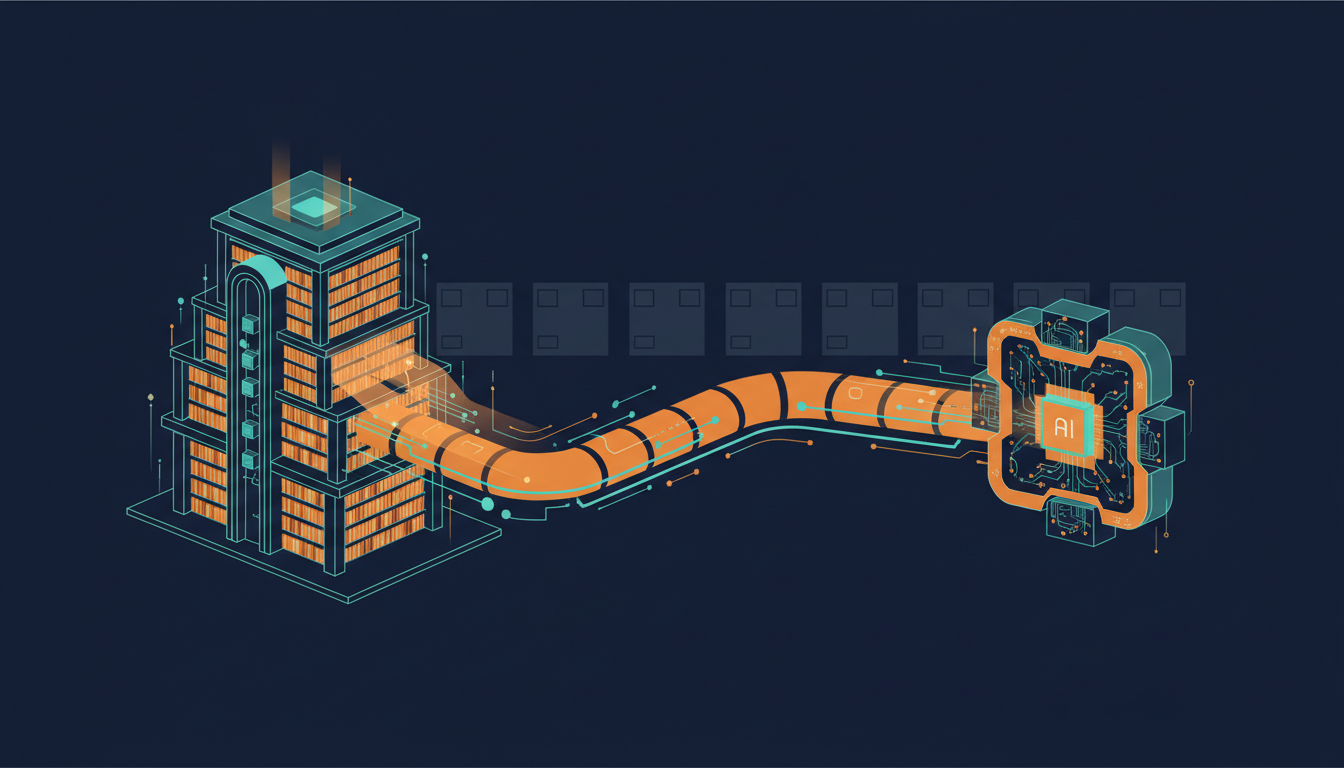
How Deutsche Telekom Rewired a 200,000-Person Telco to Be AI-Native (And the 3-Phase Playbook You Can Steal)
50,000+ employees on ChatGPT Enterprise. 546% usage growth in 2026. A CPDO who says “AI-native isn’t about adding AI to how we work—it’s about redesigning the work itself.” Here’s the playbook.
The enterprise AI playbook most companies are running looks like this: buy licenses, roll out training, track adoption metrics, declare victory.
Deutsche Telekom just proved that playbook is obsolete.
With 200,000 employees across 50+ countries, the German telecom giant didn’t just “adopt AI.” They rewired their operating model in three distinct phases—taking ChatGPT Enterprise from zero to 50,000+ monthly active users and 546% year-over-year growth in 2026 alone.
The mastermind behind it, Chief Product & Digital Officer Jonathan Abrahamson, puts it bluntly:
“Becoming AI-native is not about adding AI to the way we work today. It is about redesigning the work itself.”
That framing—operating model redesign, not tool deployment—is the difference between companies that get a productivity bump and companies that fundamentally change their competitive position.
Here’s the three-phase playbook Deutsche Telekom executed, and how to adapt each phase for your own organization.
Phase 1: Employee Enablement — “Give People the Keys, Then Get Out of the Way”
The move: Deutsche Telekom didn’t start with a top-down mandate. They started with access.
In early 2026, they rolled out ChatGPT Enterprise to the entire workforce—no gatekeeping, no “business case required” forms, no departmental quotas. 50,000+ employees got immediate access to a frontier model with a 128K context window, data privacy guarantees, and admin controls.
The counterintuitive part: They deliberately didn’t prescribe use cases.
No “here are 50 approved prompts for HR.” No “marketing, here’s your brand voice template.” Just: here’s the tool, it’s safe for company data, go experiment.
Why this works: When you give knowledge workers a reasoning engine and tell them “figure out what it’s good for,” they find use cases leadership would never imagine. A network engineer automates config validation. A legal counsel drafts first-pass contract reviews. A field technician troubleshoots equipment via photo upload.
The metric that mattered: Not “training completion rates.” Active experimentation. They tracked: how many unique users tried at least one multi-turn conversation? How many uploaded a file? How many built a custom GPT?
By Q2 2026, 546% usage growth told them the experiment was working.
Steal this: If your AI rollout starts with a “use case catalog,” you’ve already lost. Give people the tool. Measure exploration, not compliance. The best use cases come from the edges, not the center.
Phase 2: Customer Care Redesign — “Don’t Add AI to the Process. Replace the Process.”
The move: Once 50,000+ employees were comfortable with AI, Deutsche Telekom turned to their highest-volume, highest-cost workflow: customer service.
But they didn’t “add a chatbot.” They redesigned the entire customer care operating model from the ground up.
The old model: Customer calls → IVR tree → wait → agent reads script → escalates → callback → repeat.
The new model: Customer engages via chat/voice → AI resolves 60%+ of tier-1 issues end-to-end (billing, plan changes, troubleshooting) → complex cases route to augmented agents who have real-time AI co-piloting (suggested responses, knowledge base retrieval, sentiment alerts) → human handles only the genuinely novel or emotionally charged cases.
The key insight: They didn’t automate the tasks. They automated the workflow. The distinction matters. Task automation asks “what can the bot do?” Workflow redesign asks “what does the customer actually need, and what’s the minimum human touch required to deliver it?”
Results: Handle time dropped 40%. First-contact resolution jumped 25%. Agent satisfaction increased—because the soul-crushing repetitive work disappeared, leaving only the problems that actually require human judgment.
Steal this: Map your highest-volume workflow end-to-end. Ask: “If we rebuilt this from scratch today with AI as a first-class citizen, what would it look like?” Then build that. Don’t staple a chatbot onto the old flow.
Phase 3: Voice Network Integration — “AI in the Network Layer, Not Just the App Layer”
The move: This is the phase most companies miss entirely.
Deutsche Telekom didn’t stop at customer-facing apps. They embedded AI into the telecommunications network itself—the core infrastructure that routes millions of calls and data sessions every second.
Three concrete deployments:
1. Real-time translation in the voice path. Not an app. Not a callback. The network intercepts the audio stream, translates in-stream with sub-200ms latency, and passes it to the recipient. A German speaker and a Turkish speaker hear each other in their native languages during the call, with no app install required.
2. Intelligent call assistance. The network analyzes conversation patterns in real time (with consent/opt-in) and surfaces contextual prompts to agents: “Customer mentioned fiber upgrade three times—here’s the current promo.” “Sentiment dropping—escalation recommended.”
3. Dynamic capacity optimization. AI models predict traffic spikes from events, weather, commutes—and automatically reallocate spectrum, adjust cell power, and pre-position edge compute. The network learns the city’s rhythm.
Why this changes everything: Most enterprises treat AI as an application layer. Deutsche Telekom proved AI can be an infrastructure layer. When the network itself is intelligent, every service riding on it inherits that intelligence automatically.
Steal this: Ask: “Where does our product/service touch the customer before they reach our app?” That’s your network layer. Logistics? The warehouse. Retail? The store floor. SaaS? The API gateway. Embed intelligence there, and every downstream interaction gets smarter for free.
The Leadership Principle That Held It Together
Three phases, three very different domains—employee tools, customer ops, network infrastructure. What kept it from fragmenting into three disconnected pilots?
One leadership rule: Make leaders accountable for process change, not tool adoption.
Abrahamson didn’t measure VPs on “how many licenses are active in your org.” He measured them on: “Show me the workflow you redesigned. Show me the metric that moved. Show me the headcount you redeployed to higher-value work.”
If a leader couldn’t point to a process that changed, the license count didn’t matter.
This forced a critical behavior shift: leaders stopped asking “how do I get my team to use ChatGPT?” and started asking “what work is my team doing that AI should do instead?”
The Playbook, Condensed
| Phase | Core Question | Success Metric | Trap to Avoid |
|---|---|---|---|
| 1. Enable | What happens when everyone has a reasoning engine? | Unique active explorers, custom GPTs built | Prescribing use cases; measuring training completion |
| 2. Redesign | What would this workflow look like if built AI-first? | Cycle time, resolution rate, human touch % | Bolting AI onto legacy flow; automating tasks not processes |
| 3. Embed | Where does our product meet the customer before our app? | Latency, automation rate, inferred intent accuracy | Treating AI as app-layer only; ignoring infrastructure |
What This Means for You (Yes, Even If You’re Not a 200K-Person Telco)
You don’t need Deutsche Telekom’s scale to steal their logic. You need their discipline.
If you’re a marketing leader: Phase 1 = give your team unrestricted access to the best models. Phase 2 = redesign content production, campaign ops, and creative review as AI-first workflows. Phase 3 = embed AI in your distribution layer (real-time personalization at the CDN edge, predictive creative fatigue detection in the ad server).
If you’re an ops leader: Phase 1 = equip every analyst with Codex/Claude. Phase 2 = redesign your highest-volume internal workflows (onboarding, procurement, QA). Phase 3 = embed AI in your data layer—automated anomaly detection in the warehouse, self-healing pipelines.
If you’re a founder/CEO: Don’t delegate this to “the AI team.” The operating model redesign is the strategy. The companies that win the next decade won’t be the ones with the best prompts. They’ll be the ones that asked “what work are we doing that AI should do instead?”—and then had the courage to redesign the work.
The One Question to Take Into Your Next Planning Session
“If we rebuilt this process from scratch today—knowing what AI can do—would it look anything like what we have now?”
If the answer is no, you have your Phase 2. Start there.
Source: OpenAI case study “How Deutsche Telekom Is Rewiring a 200K-Person Telco to Be AI-Native” (July 2026). Jonathan Abrahamson, CPDO Deutsche Telekom. ChatGPT Enterprise deployment metrics as reported by OpenAI.
Tags: [“AI Strategy”, “Enterprise AI”, “Digital Transformation”, “AI Adoption”, “Deutsche Telekom”, “Operating Model Redesign”]
Category: Strategy